


After rounds of debate between the Houses that included “ping pong” states and dramatic U-turns, Labour’s Employment Rights Bill has finally received Royal Assent.
This means it’s now the Employment Rights Act 2025 and represents the biggest change to employment rights law in a generation.
The Employment Rights Act 1996 hasn’t been replaced. Instead, it’s been modernised, resulting in 173 pieces of new legislation, including over 28 major reforms.
What’s changing and when?
A manifesto commitment and integral to the Government’s aim to support the economy, the Employment Rights Act 2025 revamps workers’ rights, which means significant changes for business owners.
Some of the legislation will come into effect immediately, whilst others (as per the Government’s roadmap) will see a phased implementation.
A timeline of the Employment Rights Act 2025
We’ve put together a timeline to provide an overview of what changes you can expect and when.
At Royal Assent (or shortly afterwards)
Repeal of the Strikes (Minimum Service Levels) Act 2023
Prior to the Employment Rights Act 2025, although never used, legislation meant that the Government could impose minimum service levels during employee strikes.
However, credence to Labour strengthening workers’ rights, this will be repealed immediately upon Royal Assent, meaning employers will lose their power to issue “work notices”.
Resulting from this, there could be operational disruption across key sectors such as health, transport, and fire and rescue.
Repeal of the majority of the Trade Union Act 2016
A simple majority of those who will vote will be enough, removing the 50% turnout threshold that was previously required for a ballot to be valid. The 40% support threshold needed in “important public services” has also been removed.
Resulting from this, it’ll be much easier for unions to acquire a legal mandate for action, meaning employers could be subject to strikes—even if it’s supported by the minority of the workforce.
Removal of the 10-Year political fund ballot requirement
Instead of unions requiring to re-ballot members every 10 years to preserve political funds, they must notify members every 10 years of their right to opt out.
Consequently, unions’ foundations will be stabilised with long-term financial support for political campaigns. Administrative and financial implications are mitigated, strengthening unions’ position and influence.
Simplification of industrial action and ballot notices
To take industrial action, the notice period was 14 days, that’s been changed to 10. Furthermore, unions won’t need to provide as much detail, such as the explicit number of employees expected to be involved.
These changes give employers less time and data to respond, which could have ramifications on business productivity.
Enhanced dismissal protections for industrial action
Revisions to the Employment Rights Act has removed the 12-week limit on protection from unfair dismissal involved in lawful industrial action.
Should employers wish to dismiss employees because of lawful industrial action, it will be deemed automatically unfair, irrespective of how long the strike lasts. Employers must rely on negotiation to resolve disputes.
April 2026
Doubling the maximum collective redundancy protective award (Max 90 days' pay to Max 180 days' pay)
When businesses undergo redundancies that affect 20 or more employees, employers are duty bound to collectively consult those concerned.
Incorrect consultation can lead to a “protective award” for each impacted employee, posing substantial financial risks for employers.
Removal of service requirement for paternity leave and parental leave
Perhaps the most significant aspect of the Employment Rights Act 2025 is host of new day one rights for employees. The 26-week service requirement has been removed for paternity leave, as has the 12-month requirement for parental leave.
Notice periods will still apply, but such requests must be handled by employers as soon as employers start their job. New starters will mean added admin for employers, as well as the risk of dealing with being understaffed.
Whistleblowing protections for protected disclosures regarding sexual harassment
Whistleblowing and reporting sexual harassment, internally or externally, is going to be categorised as “protected disclosures”. Though certain tests must be met, for example, allegations must be in the public interest—so not every claim will be protected.
Internal reporting processes, strict policies covering retaliations, and extensive training will be critical for employers so disclosures can be handled delicately.
The Fair Work Agency Body
To consolidate the powers held by numerous agencies, the Employment Rights Act 2025 will establish a single body, the Fair Work Agency, to streamline matters.
Workers’ rights like the National Minimum Wage, holiday pay and agency worker regulations will become more efficient. Employers can expect a unified enforcement entity with greater powers like conducting inspections and issuing fines.
Removal of lower earnings limit and waiting period for statutory sick pay (SSP)
The three-day waiting period for statutory sick pay has been removed, as has the threshold that an employee must earn at least the lower earnings limit per week to receive payment.
Eligible workers, regardless of their usual earnings, will now be entitled to SSP from their first day of sickness. This will be paid at either 80% of usual earnings, or the current statutory rate, whichever is lower. Because of this, payroll costs with short-term and frequent absences are likely to increase for business owners.
Simplification of trade union recognition process
Legal process through the Central Arbitration Committee (CAC) to gain recognition from an employer will be refined.
Trade unions will secure official workplace bargaining rights with increased ease and speed. Employers could face being embroiled in negotiations concerning pay, hours, and holidays.
Electronic and workplace balloting reforms
Presently, unions must post physical ballots to members’ homes. However, the new Employment Rights Act will likely facilitate e-voting or in-workplace balloting.
Increased voter turnout in union ballots may be the outcome from this legislation. A higher turnout means it’s easier for unions to obtain a majority needed for lawful strike action.
October 2026
Requirement to inform workers of their right to join a trade union
It’ll be a legal requirement for employers to provide their workers a written statement that they have a right to join a trade union.
Sectors with low trade union influence may see a surge in increased membership and higher demand for collective bargaining. From an admin perspective, businesses must update their documentation.
Employers must take “all reasonable steps” to prevent sexual harassment
Essentially, the Act aims to strengthen existing law—making it difficult for employers to argue that a policy being in place is enough. There is an onus on being proactive, in fact, it’s a legal duty for employers to take “all reasonable steps”, rather than “reasonable steps”.
During litigation, the burden of proof falls on the employer. They must illustrate extensive evidence of action that they took “all reasonable steps” to prevent sexual harassment.
Download our free sexual harassment policy template for additional support in protecting your staff and business.
Obligation for employers to prevent harassment by third parties
Liability for employers when their staff are harassed by third parties (customers, clients, patients or contractors) is much broader. Previously, employers weren’t responsible for the actions of non-employees—employers will have a legal duty to prevent this.
Risk assessments should be conducted so businesses have a better understanding of how the public engage with their staff. Employers who don’t demonstrate preventative control measures will face costly tribunal claims.
Extension of employment tribunal time limits (3 months to 6 months)
The statutory window for an employee to lodge most claims, including unfair dismissal, discrimination, and breach of contract, will increase to six months from three.
Retaining detailed records, witness contact details and evidence is advisable. It’s forecast that this change will spark higher volume of claims reaching the tribunal system.
Tightening of tip laws
Amendments coming from the Employment Rights Act 2025 will see big changes to tips for employees and employers in the hospitality sector.
When the new law comes into effect, employers will be legally mandated to renew their tips policies every three years, ensuring total transparency when consulting with their staff.
Strengthening of trade unions’ right of access
Trade union officials will have access to employers’ workplace for the purposes of recruiting and meeting with workers. Such arrangements will no longer be at the employer’s discretion.
Workplace control will shift, and employers must enter “access agreements” with trade unions. The Act does state that access must be reasonable and not cause disruption to business operations.
Introduction of new rights and protections for trade union representatives
Protections for union representatives are galvanised against detriment and dismissal, and their right to paid time off for union duties is to be expanded.
There will be protection for being targeted by employers for instigating industrial action or representing members.
When managing performance or conduct of a union representative, employers must exercise caution to avoid claims of automatic unfair dismissal or detriment. Employers need detailed documentation and justification for action against union representatives.
Extension of the protections against detriments for taking industrial action
Workers are protected from any detriment—being overlooked for promotion, losing shifts or bonuses—if they’ve participated in lawful industrial action.
In the past, employers may have relied on benefits to incentivise breaking strikes. However, this new Act limits the options at the disposal of business owners.
Fair Pay Agreement: Adult Social Care Negotiating Body
Negotiating sector-wide minimum pay, terms, and conditions for the adult social care workforce will be governed by a new statutory body.
Care providers will not be able to set competitive pay according to their individual margins. They’re to be legally bound by the rates negotiated by the new national body. This could lead to financial pressure on private providers.
1st January 2027
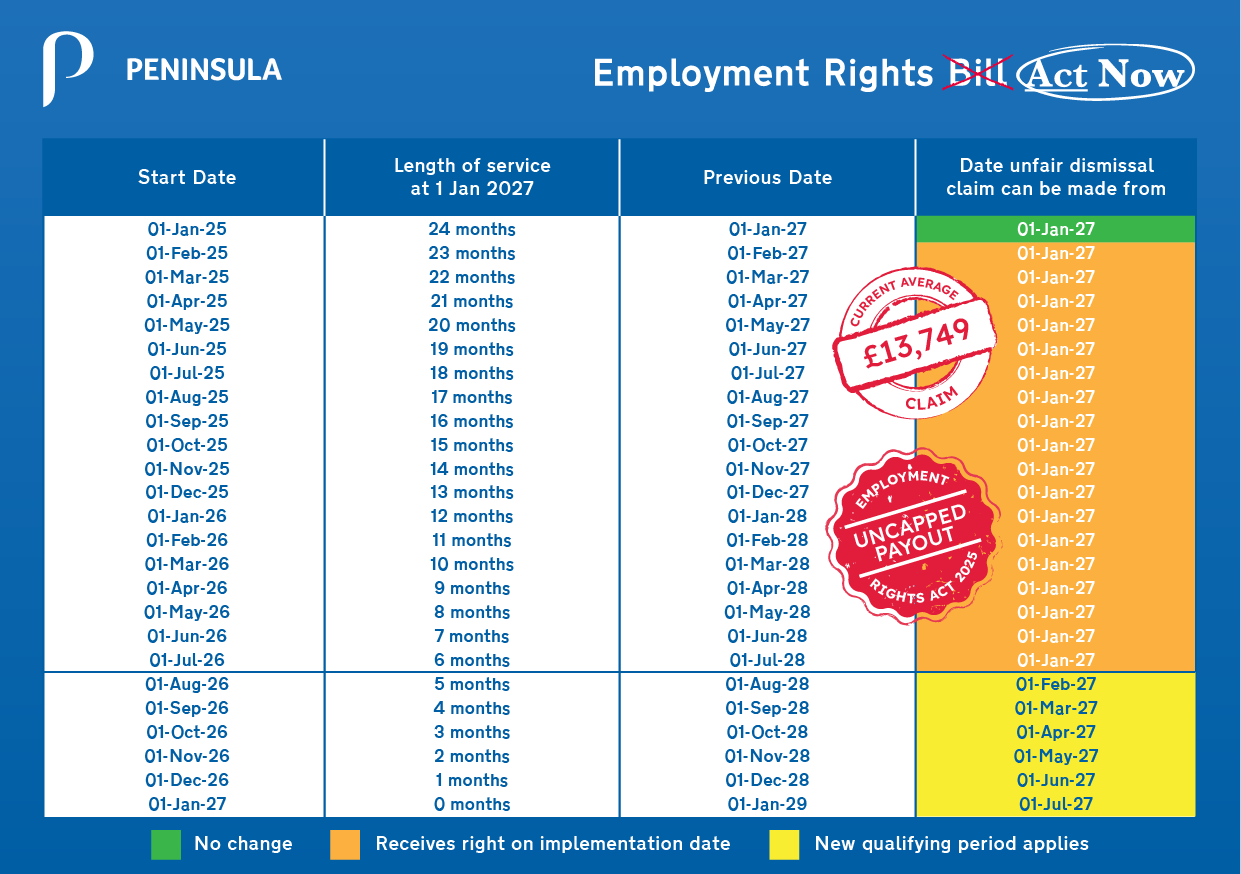
Introduction of six-month qualifying period for unfair dismissal
Infamously, we saw Labour U-turn on what was intended to be a day one right for employees.
Importantly, the implementation of this is retrospective. If an employee has six months’ service by the 1st January 2027, they’ll be entitled to make a claim of unfair dismissal.
Responding to this, employers should tighten recruitment so they can retain talent, as well as reviewing their probationary period process (a six-month probation period is now too long) to thoroughly test employees.
The below graphic illustrates the implications:
January 2027
Fire and rehire restrictions
Unless an employer proves they’re facing financial distress that threatens their business, and they’ve exhausted all options, under new rules, most fire and rehire dismissals are automatically unfair.
Businesses must seek negotiation and voluntary agreement. If they do go forward with dismissal without satisfying the “business viability” threshold, employers will be subject to expensive unfair dismissal claims.
Later in 2027
Requirement to justify refusal of flexible working requests
Refusing a flexible working request must not be solely based on one of the eight statutory grounds, it must be objectively reasonable. Employers must provide a written explanation outlining why the refusal is reasonable.
Each request for flexible working must be dealt with on a case-by-case basis. Not providing an adequate justification could lead to tribunal claims.
Regulations specifying "Reasonable Steps" to prevent sexual harassment
As discussed, employers have a duty to take “all reasonable steps” to prevent sexual harassment. The Employment Rights Act 2025 gives the government power to stipulate regulations defining what they are.
Ambiguity is removed, and it’s paramount that employers can showcase they’re being proactive—this could be a case of evidencing that every step of statutory regulations have been met.
Right to guaranteed hours and shift protections
“One-sided flexibility” was something Labour were keen to address. To achieve that, zero-hours, low-hours, and agency workers will gain the right to a guaranteed hours contract.
Operationality could be hindered as businesses can no longer rely on a workforce without commitment. Also, employers must pay attention to working patterns and be aware that cancelled shifts result in financial penalty.
Introduction of unpaid bereavement leave (including pre-24-week miscarriages)
Compassionate leave policies that vary from employer to employer will be replaced with a statutory right to unpaid bereavement leave for all employees.
Bereavement will also encompass miscarriages that occur before the 24th week of pregnancy—it’s legally classified as a stillbirth at this point.
Leave policies should be updated by employers to reflect that this is now a day one right for all employees. Businesses should also consider how they’ll manage short-term absences.
New collective consultation thresholds for redundancy
How collective consultation is calculated will change. The requirement to consult was triggered if an employer intended making 20 or more redundancies at a single "establishment".
“Establishment” has been removed as a qualifier under the Employment Rights Act 2025, and the threshold is calculated across the entire business.
Under old legislation, a company had the right to make 15 redundancies at 10 different sites without collective consultation. Businesses with multiple sites should be especially mindful of this reform.
Extension of the rights and protections for pregnant workers
Pregnant workers, and those returning from family-related leave, will have improved protections from dismissal during a protected period. It will be unlawful to dismiss them—except in very specific cases.
Furthermore, the protection covers the entirety of the pregnancy and continues for six months after the employee returns to work. Resulting from this, employers must navigate a protective period that can last up to two years.
Introduction of an industrial relations framework and blacklisting provisions
Designed to formalise the partnership between employers and unions, the Employment Rights Act 2025 introduces the Industrial Relations Framework. A key element is added support of anti-blacklisting provisions.
Based on their trade union membership or activities, employers cannot create, use, or share blacklists of individuals—including taking part in industrial action or acting as a representative.
Lending to this new framework, if an applicant can show they were denied employment due to their union history, an employer could be subject to financial penalties and automatic unfair recruitment claims.
Stricter regulation of umbrella companies
With an aim to combat non-compliance in the umbrella company market, the Government is introducing a statutory regulatory framework.
It includes a legal definition of an umbrella company and provides the new Fair Work Agency with powers to investigate and punish those guilty of tax avoidance. Also, new due diligence requirements transfer legal and financial liability onto the end-user businesses.
Thorough auditing of employers’ supply chains should be conducted, and they must implement “approved supplier lists” (ASLs), as well as demand “pay illustrations”, ensuring workers receive all statutory entitlements.
Mandatory gender pay gap and menopause action plans
Large employers will be required to publish action plans—data reporting is not sufficient. Said plans should set out measurable steps the business is implementing to tackle its gender pay gap, as well as how its supporting employees experiencing menopause.
We’re witnessing a move from transparency to accountability. Reporting a pay gap without consequences is indicative of old law. Employers will have to show justification and prove they’re trying to remedy it.
Regarding menopause, employers must treat it as a formal workplace health and equality matter. Therefore, new policies may have to be drafted to accommodate for these changes. Download our free menopause policy template
Concluding Employment Rights Act 2025: What you need to know
Long-awaited, but with changes of this magnitude, it’s no surprise that we saw several Employment Rights Bill amendments in the lead up to Royal Assent.
For workers and employers alike, the Employment Rights Act 2025 symbolises a seismic shift, and one way or another, people will be impacted—be that positively or negatively.
From employees gaining day one rights, as well as other protections, and trade unions having increased influence, businesses are going to have a lot to contend with.
Let Peninsula prepare you for the Employment Rights Act 2025
Legal obligations have been overhauled, and workers’ rights have been reshaped. Whether it’s now or in the future, you’ll need to respond to these changes to ensure compliancy.
Unsure how? Book a free Impact Assessment here for a tailored plan and peace of mind.
If you’re feeling overwhelmed and have concerns about what this means for you and your business, we’re here to offer guidance.
Peninsula has four decades of HR experience; we blend expertise with empathy to deliver exceptional service.
When you partner with us, you’ll get access to 24/7 advice, unlimited support with your documentation, and market-leading HR software.
Learn about the full benefits. Book a call today.


