In the United Kingdom, a Green Belt is a planning policy designed to preserve open land surrounding urban areas. The aim is to ensure towns are separated with boundaries, maintain the countryside, and protect historic town settings.
Using national policy, Green Belt land is defined by Local Planning Authorities (LPAs) in their local plans. Whilst a purpose of the green belt is to keep land open, public access isn’t always legally granted.
As per the National Planning Policy Framework (NPPF), five key objectives are fundamental to the Green Belt:
1. Preventing urban sprawl by controlling unrestricted growth in built-up areas.
2. Stopping coalescence (preventing neighbouring towns merging and mitigating the loss identities).
3. Ensuring the countryside isn’t impacted by urban development.
4. Maintaining towns’ historic settings.
5. Promoting regeneration through recycling derelict and other urban land.
How do I find out if land is Green Belt?
To establish if a piece of land is Green Belt, you can use official government resources and interactive mapping tools.
Firstly, refer to your LPA. They will have a local plan complete with Green Belt boundaries legally defined at a local level. You could also contact your council’s planning officer for confirmation.
An interactive Green Belt map is also a useful means to find answers. The government’s prototype map is the most official digital tool, which is automatically updated with data by local authorities.
Other examples include:
- The CPRE Interactive Map
- Urbanist Architecture Map
- MAGIC Map
Green Belt map
Let’s take a look at the Green Belt map:
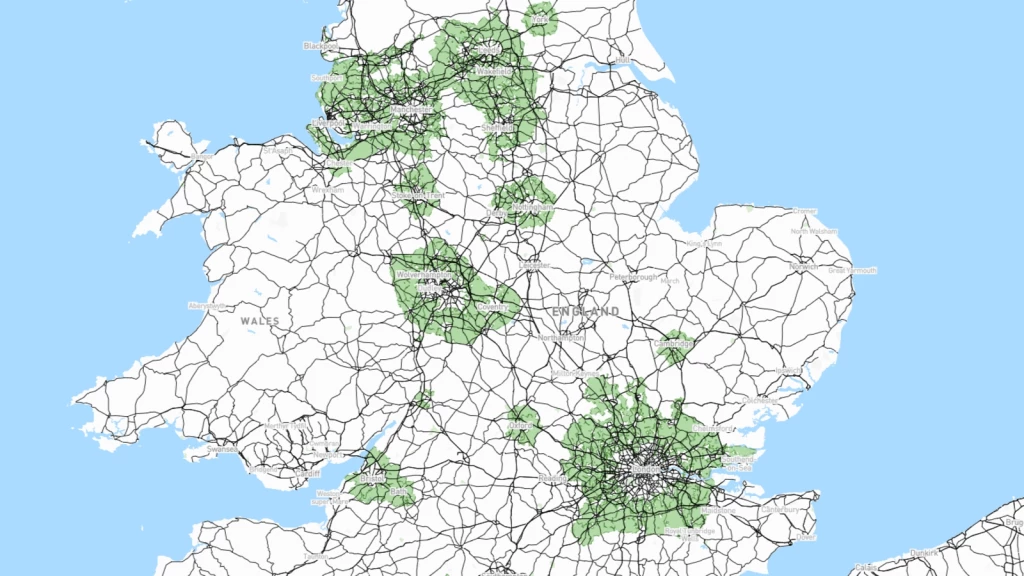
Green Belt of London
Here’s an image of the London Green Belt map:
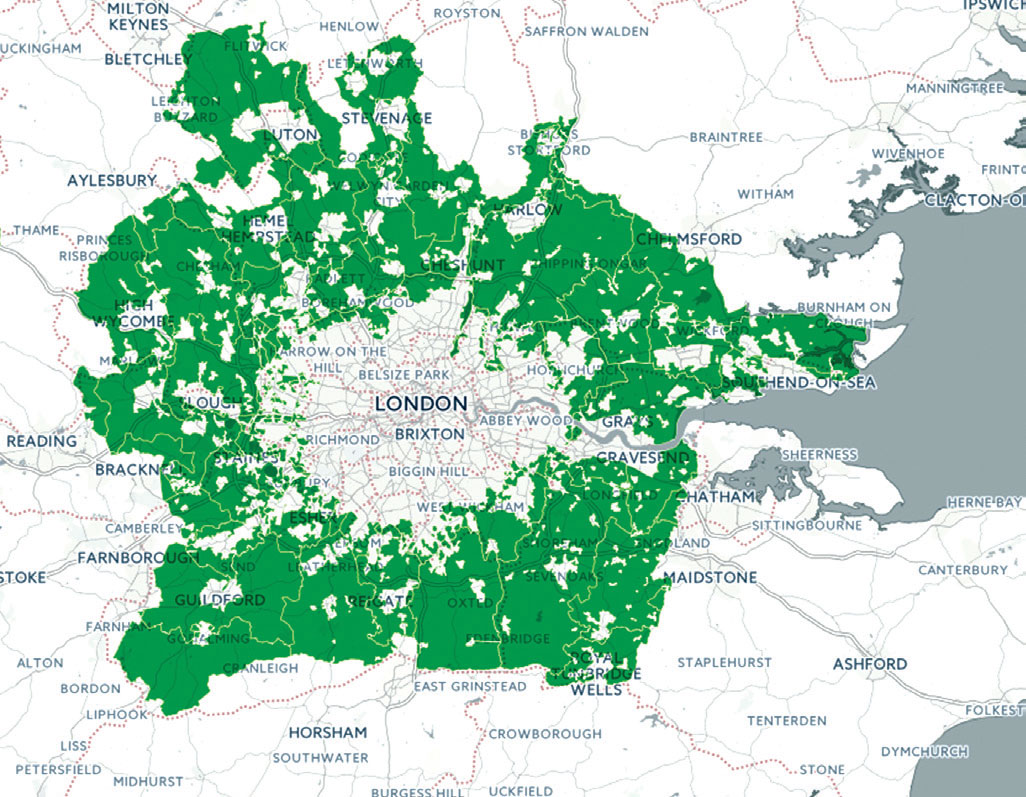
Can you build on Green Belt land?
Building is permitted, but it’s usually only allowed under certain conditions that do not undermine the purpose of Green Belt planning policy—for example, the land must serve its primary purpose of preventing urban sprawl.
Extensions are likely to be governed by Permitted Development (PD) with stringent rules. Substantial new developments will require proof of an exceptional need.
This could be a housing shortage, or evidence that the proposals will improve an area’s environmental or design value—as outlined in the Grey Belt rules.
Should you rely on contractors for any building work, download free contractor questionnaire template here.
What is Grey Belt land?
They Grey Belt is a specific category of land within the Green Belt that’s been identified as suitable for sustainable development under the revised NPPF. It was introduced to tackle the housing crisis by accelerating delivery on poor quality land within the Green Belt.
For land to be considered Grey Belt, it must satisfy certain criteria. Firstly, there’s the physical state element; it must be previously developed land—brownfield—or make little to no contribution to Green Belt purposes. This includes underutilised sites such as disused car parks, petrol stations, quarries, and “edge-of-town” scrubland.
Secondly, there’s the functional test. As per the Planning Practice Guidance, the land must not obstruct the following Green Belt aims:
- Stopping unrestricted urban sprawl
- Ensuring neighbouring towns don’t merge
- Protecting historic settings within towns
National Parks, Areas of Outstanding Natural Beauty (AONBs), or Sites of Special Scientific Interest (SSSIs) are excluded.
Grey Belt “Golden Rules” for development
Any developments on Grey Belt land must adhere to the “Golden Rules”. Here’s an overview of them:
- Affordable housing: A minimum of 50% affordable housing is needed for residential schemes—or 15% above the local plan requirement.
- Infrastructure: Local or national infrastructure improvements, like schools, GP surgeries, and transport, must be funded by developers.
- Public green space: Accessible green spaces must be made for the public that are a short walk from their new homes.
Can you run a business on Green Belt land?
Provided strict controls are followed, it is possible to run a business on Green Belt land. It is however restricted to businesses that are deemed appropriate and must not interfere with Green Belt principles.
Here are some examples:
- Agriculture and forestry: Farming, and related businesses, regularly use Green Belt land and are usually permitted.
- Outdoor sport: Sports fields, along with associated buildings, are allowed if they don’t impede the land’s open nature.
- Re-use of existing buildings: If planning permission is granted, old buildings may be converted for commercial use.
- Limited alterations: Existing buildings may have extensions allowed. They must not be disproportionate to the original building size.
FAQs: What is the Green Belt?
Can business owners build new commercial or industrial buildings on Green Belt land?
Only under very specific circumstances. The Green Belt is still protected, but building may be permitted according to Grey Belt rules—land that is low quality and has limited contribute to Green Belt purposes. The “Golden Rules” must be satisfied.
What is the Grey Belt, and how does it help businesses?
The Grey Belt classifies land within the Green Belt that was previously developed (brownfield) or areas that don’t serve Green Belt purposes—old car parks and wasteland. Businesses could open sites without the need to meet certain requirements.
What is the Grey Belt Golden Rules?
There must be a minimum of 50% affordable housing for residential schemes, local or national infrastructure must be funded by developers, and there must be accessible green spaces within walking distance from new homes.
What role employers play in Local Plan reviews?
Local Planning Authorities (LPAs) must review Green Belt boundaries if they cannot meet mandatory housing and commercial targets. As stakeholders, employers should liaise with their council to push for the release of land for infrastructure and business hubs.
Final say: What is the Green Belt?
Essentially, the Green Belt meaning is to prevent unrestricted urban development, preserve the country’s natural rural beauty, help towns preserve their identity along with historic settings, and promote regeneration.
However, given that there this a housing crisis, we have seen the introduction of the Grey Belt. This is an approach that aims to create affordable housing within the Green Belt without breaking any of its core principles.
Get expert guidance covering the Green Belt with Peninsula
Laws governing Green Belt land can be confusing, but if you’re planning on operating a business from a piece of protected land, understanding Green Belt planning policy is vital.
Peninsula’s expertise ensures that your business stays compliant amidst intricate legislation and policies.
In fact, when you partner with us, you’ll get 24/7 Health & Safety support, regular refreshes of your documentation, and market-leading software.
Learn how we can help you and contact us here.