


Noise and vibration are workplace health hazards that can affect employees across almost every industry. Although they are often associated with construction and heavy engineering, exposure can also occur in manufacturing, warehouses, garages, transport operations, agriculture, grounds maintenance, cleaning, hospitality, entertainment venues, healthcare estates and other workplaces.
Workers may be exposed through machinery, vehicles, powered hand tools, production equipment, cleaning machines and maintenance activities. Because the effects of exposure can develop gradually, workers may not immediately recognise that their health is being affected.
Prolonged or excessive noise can contribute to permanent hearing damage and tinnitus. It can also create an immediate safety concern if workers are unable to clearly hear instructions, warning signals, alarms or approaching vehicles and machinery.
Vibration presents different risks. Regular use of vibrating hand-held, hand-fed or hand-guided equipment can contribute to hand-arm vibration syndrome (HAVS) and carpal tunnel syndrome. Employees operating certain vehicles or mobile machinery may also be exposed to whole-body vibration. For employers, the priority is to identify potentially harmful exposure early and prevent or adequately control it before employees' health is affected.
Legal Duties
The Control of Noise at Work Regulations 2005 require employers to assess the risks created by workplace noise and take appropriate action to prevent or reduce exposure. The Regulations establish a lower exposure action value of 80 dB(A) and an upper exposure action value of 85 dB(A), based on daily or weekly personal noise exposure.
Where employees are exposed to workplace noise, employers may need to assess exposure, implement suitable controls, provide employees with information and training, provide suitable hearing protection where required and arrange health surveillance for workers who are at risk.
Vibration exposure is covered by the Control of Vibration at Work Regulations 2005. Employers must assess risks from vibration and eliminate exposure at source were reasonably practicable. Where elimination is not reasonably practicable, exposure should be reduced to as low a level as is reasonably practicable.
Employers should consider both hand-arm vibration, which can occur through the use of vibrating tools and equipment, and whole-body vibration, which may affect workers who regularly operate certain vehicles or mobile machinery.
Risk assessments should remain under review and be updated where circumstances change, such as when new machinery or equipment is introduced, working methods change or there is evidence that existing precautions may no longer be effective.
Control Measures
Managing noise and vibration effectively begins with the hierarchy of controls. Wherever reasonably practicable, employers should first consider whether the hazardous activity can be eliminated altogether. Where this is not possible, alternative working methods, equipment or processes that produce less noise or vibration should be considered.
Engineering controls provide the next important layer of protection. For noise, this can include isolating machinery, installing acoustic enclosures or barriers, reducing sound transmission and separating noisy activities from other work areas. For vibration, employers should consider equipment design, isolation and damping measures. Machinery, vehicles and tools should also be properly maintained, as deterioration and damaged or worn components may contribute to unnecessary noise or vibration.
Administrative arrangements can further reduce exposure. Work can be planned to limit the amount of time employees spend carrying out higher-exposure activities, restrict unnecessary access to affected areas and minimise the number of people exposed.
Personal protective equipment should not be relied upon as the main means of controlling a hazard where more effective controls are reasonably practicable. Where hearing protection is necessary, it must be suitable for the level and type of noise involved, properly maintained and correctly used.
Key Safety Measures
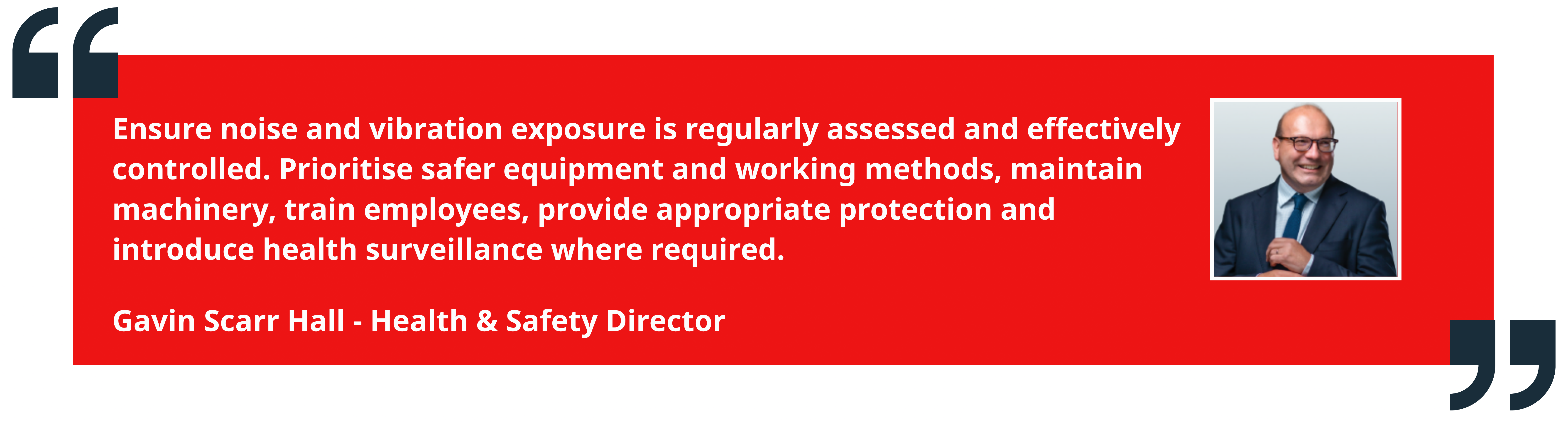
Employers should start by identifying activities, equipment and areas where workers could be exposed to harmful levels of noise or vibration. The assessment should look beyond obviously noisy or heavy equipment and consider everyday activities such as maintenance, cleaning, grounds work, vehicle operation, workshop activities and the use of powered or battery-operated tools. Exposure should be considered in terms of both its level and how frequently and for how long workers are exposed.
Where significant exposure is identified, priority should be given to controlling it at source. Quieter or lower-vibration equipment should be selected where reasonably practicable and purchasing decisions should take occupational noise and vibration into account. Machinery, tools and vehicles should be properly maintained and inspected so that defects or deterioration do not unnecessarily increase exposure.
The organisation of work can also make an important difference. Employers should consider separating noisy activities from other work areas, restricting access where appropriate and planning work to reduce the duration and frequency of employee exposure. For vibration, simply rotating employees should not be used as a substitute for reasonably practicable measures that reduce the vibration produced by the activity or equipment itself.
Employees should receive suitable information, instruction and training on the risks associated with noise and vibration. They should understand the controls in place, the correct use of equipment and any hearing protection provided, and the importance of reporting defects, concerns or early symptoms of ill health.
Where the risk assessment identifies a need, appropriate health surveillance should also be introduced. This can help detect signs of noise-induced hearing damage or vibration-related ill health at an early stage and can provide useful information about whether existing controls remain effective. However, health surveillance should support effective preventative controls, not replace them.
Workers should also be encouraged to report symptoms promptly. Hearing difficulties, persistent ringing in the ears, numbness or tingling in the hands and fingers, loss of grip strength or other symptoms potentially associated with workplace exposure should not simply be accepted as an unavoidable part of the job.
Summary
Noise and vibration are not hazards limited to construction. A vehicle technician using an impact wrench, a grounds worker operating powered equipment, a cleaner using machinery, a warehouse employee working around noisy equipment or a manufacturing operative working with production machinery may all experience occupational exposure.
Employers should therefore focus on the activity being carried out, equipment being used and actual level, duration and frequency of exposure, rather than assuming that particular workplaces or occupations are automatically low risk.
Effective protection starts with identifying and assessing the exposure, followed by eliminating or reducing it at source wherever reasonably practicable. Engineering and organisational controls, effective equipment maintenance, employee training, appropriate PPE and health surveillance can then provide additional layers of protection.
Taking action before symptoms appear is particularly important. Hearing damage and vibration-related conditions can have long-term consequences, whereas effective assessment and early control can help prevent occupational ill health developing in the first place.


