


Lung Cancer Awareness provides an important opportunity for employers to consider how the workplace can affect employees’ long-term respiratory health. While smoking remains a major risk factor for lung cancer, workplace exposures can also contribute to the development of serious and potentially life-threatening respiratory diseases.
Employees can be exposed to hazardous dusts, fibres, fumes, gases and other substances during everyday work activities. In some industries, exposure may involve substances associated with an increased risk of lung cancer, including asbestos and respirable crystalline silica (RCS). The effects of occupational exposure may not become apparent for many years, making prevention particularly important.
Employers should therefore look beyond immediate accidents and injuries and consider the long-term health consequences of the work their employees undertake. Effective risk assessment, suitable control measures and, where required, health surveillance all play an important part in protecting workers' lung health.
History of Lung Cancer
Our understanding of lung cancer and its causes has developed considerably over the last century. Historically, many workers were exposed to hazardous substances without the controls, knowledge or protective equipment expected today. Industries such as construction, mining, quarrying, manufacturing, shipbuilding and stone working have all presented significant occupational respiratory risks.
It is now well recognised that workplace exposures can contribute to lung disease and cancer. Asbestos exposure, for example, is associated with lung cancer as well as mesothelioma, while exposure to respirable crystalline silica can cause silicosis and is also associated with lung cancer.
One particular challenge is the long period that can exist between exposure to a hazardous substance and the development of disease. An employee may therefore develop serious health problems many years after their original workplace exposure.
Lung Cancer Awareness is consequently not only an opportunity to raise awareness of symptoms and personal risk factors. For employers, it is also an opportunity to consider whether work activities are exposing people to substances that could affect their health many years into the future.
Employers' Duty of Care
Employers have a legal responsibility to protect the health, safety and welfare of their employees and others who may be affected by their work.
Under the Health and Safety at Work etc. Act 1974, employers must, so far as is reasonably practicable, protect employees' health, safety and welfare. This includes managing risks that could cause long-term occupational disease, not simply preventing accidents.
Where hazardous substances are present, the Control of Substances Hazardous to Health Regulations 2002 (COSHH) are particularly important. Employers must assess the risks created by hazardous substances and prevent exposure were reasonably practicable. Where prevention is not possible, exposure must be adequately controlled.
This means understanding what substances workers may encounter, how exposure could occur, who could be affected and whether existing controls remain effective.
Other legislation may also apply depending on the substance involved. For example, work involving asbestos is subject to specific requirements under the Control of Asbestos Regulations 2012.
Employers should remember that providing respiratory protective equipment alone will not normally be sufficient. Risk should be managed using the hierarchy of control, with priority given to eliminating or reducing exposure at source.
Health Surveillance
Health surveillance can be an important part of managing occupational health risks, but employers should understand its purpose.
Health surveillance is a system of ongoing health checks used where employees are exposed to particular workplace health risks. It can help identify early signs of work-related ill health and provide information about whether existing workplace controls remain effective.
Under COSHH, suitable health surveillance is required where appropriate for protecting employees who are exposed, or liable to be exposed, to substances hazardous to health.
Depending on the hazard and type of exposure, respiratory health surveillance could include:
- baseline assessment before or when exposure begins;
- respiratory health questionnaires;
- assessment of relevant symptoms;
- lung-function testing, such as spirometry, where appropriate;
- periodic reviews at intervals determined by the risk and competent occupational health advice;
- referral for further medical assessment where abnormalities or symptoms are identified; and
- maintaining appropriate health surveillance records.
Health surveillance should be proportionate to the actual risk and provided by a competent person or occupational health professional where appropriate.
Importantly, health surveillance is not a substitute for controlling exposure. An employer should not rely on medical checks to compensate for inadequate dust, fume or chemical controls. If surveillance identifies adverse health effects, this should prompt the employer to investigate exposure and review the risk assessment and control measures.
Clinical information should also be handled confidentially. Employers normally require information about fitness for work, restrictions and any necessary workplace action rather than access to an employee's confidential medical details.
Control Measures
Preventing harmful exposure remains the most effective way of protecting workers' lungs. Employers should apply the hierarchy of control when managing substances that may cause respiratory illness.
1. Eliminate the hazard
Where reasonably practicable, remove the hazardous substance or process completely. Consider whether the task needs to be undertaken in the existing way or whether a safer process can remove the exposure altogether.
2. Substitute
Replace hazardous materials or processes with less hazardous alternatives wherever reasonably practicable. For example, consider products or materials that produce less hazardous dust, vapour or fume.
3. Engineering controls
Control contaminants as close to their source as possible. Depending on the activity, this could include enclosed processes, local exhaust ventilation (LEV), on-tool extraction, dust suppression or wet-working techniques.
LEV and other engineering controls must be appropriately designed, used correctly, maintained and inspected or tested at suitable intervals.
4. Administrative controls
Develop suitable procedures for activities involving hazardous substances. Restrict access to exposure areas, minimise the number of workers exposed and reduce the duration and frequency of exposure wherever possible.
Employees should receive suitable information, instruction and training so they understand the hazards, the control measures provided and how to report defects or health concerns.
Good housekeeping is also essential. Dust should not be allowed to accumulate and working practices that unnecessarily disturb hazardous dust should be avoided.
5. Personal protective equipment
Where exposure cannot be adequately controlled by other measures, suitable personal protective equipment may be necessary. Respiratory Protective Equipment (RPE) must be appropriate for the substance, task and level of exposure and provide an adequate level of protection.
Where tight-fitting RPE, such as a disposable or reusable respirator, relies on a seal against the face, employees must undergo a suitable face-fit test for the specific make, model and size of mask they will use. Workers must also be clean shaven in the area where the respirator seals against the face, as facial hair or stubble can interfere with the seal and significantly reduce the protection provided. Where an employee cannot achieve an adequate face seal, alternative RPE that does not rely on a tight\-fitting face seal, such as a suitable powered hood or helmet, should be considered.
Employees should also receive suitable information and training on how to fit, use, check, remove, clean, store and maintain their RPE correctly.
PPE and RPE should represent the final layer of protection rather than the primary method of controlling exposure.
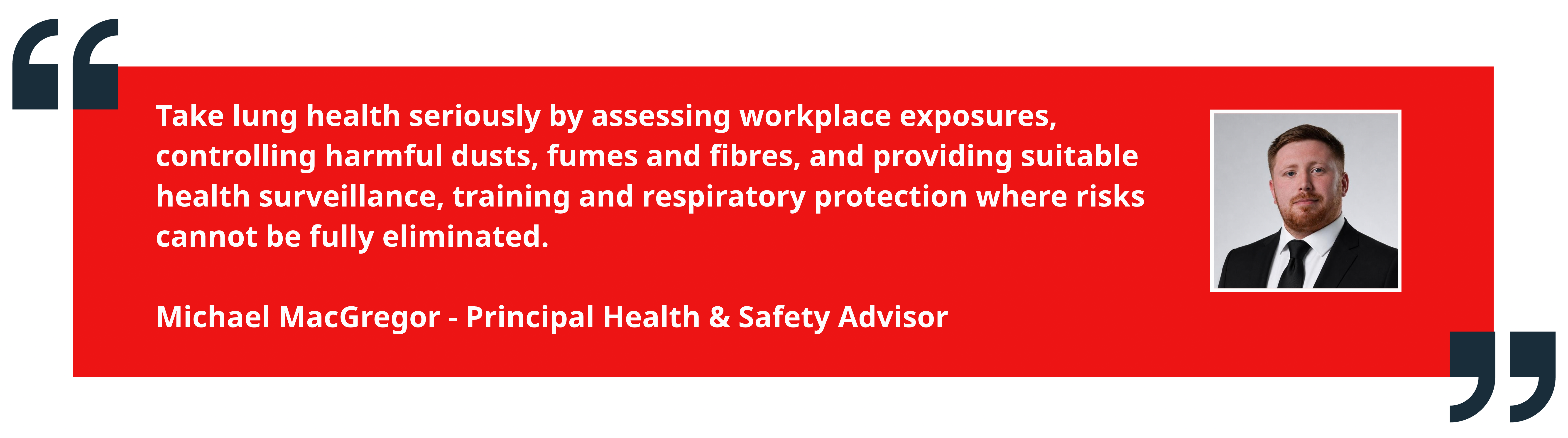
Monitor and review
Employers should regularly review COSHH assessments, exposure controls, maintenance arrangements and health surveillance findings. Changes in processes, substances, equipment or employee health may indicate that existing arrangements need to be reconsidered.
Employees should also be encouraged to report respiratory symptoms such as a persistent cough, unexplained breathlessness, wheezing, chest discomfort or other changes in their respiratory health. Workplace reporting should not replace medical assessment, and employees with concerning or persistent symptoms should be encouraged to seek appropriate medical advice.
Summary
Lung Cancer Awareness is an important reminder that protecting workers' health involves considering illnesses that can develop long after exposure has taken place. Hazardous dusts, fibres and fumes may not cause an immediate injury, but repeated or significant exposure can have serious long-term consequences.
Employers should understand the respiratory hazards within their workplace, assess exposure appropriately and apply the hierarchy of control to prevent or minimise risk. Where the legal criteria are met, suitable health surveillance should form part of the organisation's wider occupational health arrangements and should be used to identify early health effects and assess whether workplace controls remain effective.
However, health surveillance should never become a substitute for prevention. The priority must always be to eliminate hazardous exposure where possible and properly control any remaining risk.
By combining effective COSHH management, appropriate engineering controls, employee training, suitable RPE where necessary and risk-based health surveillance, businesses can take meaningful steps towards protecting their employees' lung health both now and in the years ahead.


